Bracket, Cable, Trunking, Sparky: The UK Projector Install Budget Your Cashback Deal Forgot
There is a moment, usually about forty minutes after the delivery driver leaves, when the arithmetic changes. The projector is on the sofa, the cashback claim is half-drafted, and then you look up at the ceiling and realise the box contains nothing that will hold a 5kg brick above your head.
Sticker price minus cashback is the number everyone compares, and it is also the number that tells you the least about what a projector will actually cost you. A projector does not arrive cinema-ready. It arrives as a lump of plastic with a lens at one end, a fan at the other, and a power lead that never quite reaches the socket you had in mind.
So let us do the boring bit properly, before the plaster dust starts flying.
The bracket is where a cheap deal starts leaking
Projectors do not use VESA mounting the way TVs do. Most have three or four threaded holes (usually M4 or M6) in a pattern that is unique to the brand, which is why a £22 universal bracket from a marketplace seller can turn up, fit nothing, and go back in the post. Check the manual for the mounting hole spacing and the maximum thread depth before you buy anything.
Price bands in the UK roughly shake out like this: a basic fixed bracket is £25–£45, a decent one with micro-adjustment and a proper tilt and swivel head is £55–£95, and a heavy-duty model with a drop column for high ceilings runs £100–£150. The cheap end is not automatically wrong, but it does tend to sag a millimetre or two a year, and no amount of lens shift rescues a projector that has drifted off square.
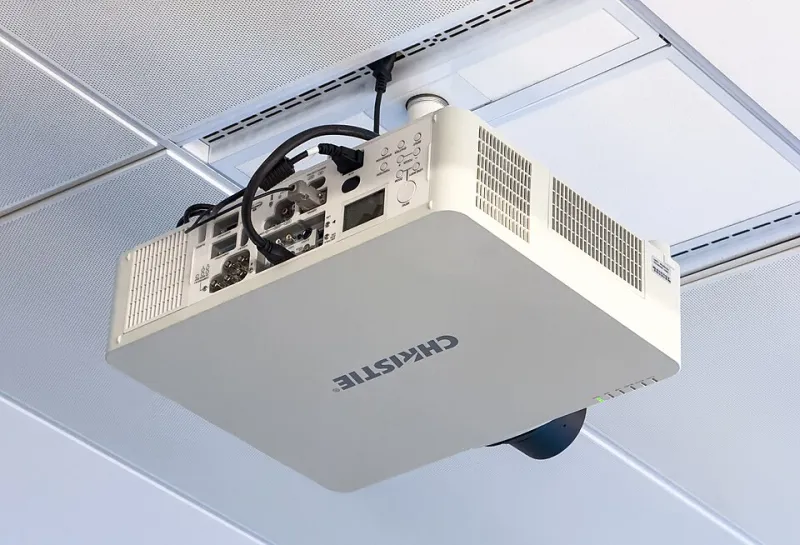
Then there is the bit nobody mentions: what the bracket is attached to. Plasterboard alone will not hold. You need joists, or a plywood pattress screwed across two of them, or resin anchors into a solid ceiling. A decent joist and cable detector is £15–£25, and it will save you a lot more than that in swearing.
Cables: the forgotten line item
A 4K projector with a passive HDMI cable is fine up to about five metres. Past that, especially at 4K/60 with HDR, you are asking a lot of copper, and the telltale symptoms — sparkles, dropouts, a handshake that takes eight seconds — usually appear a week after the returns window closes. For runs of eight metres or more, budget £40–£90 for an active or fibre-optic HDMI cable.
Buy two while you are at it. Chasing a second cable through the same route costs almost nothing now and saves a great deal of grief in three years when the first one dies.
And measure the route, not the room. A cable going up a wall, across a ceiling void and down to a shelf is routinely 1.5 to 2 times the straight-line distance. Add 20% and round up.
Trunking, power and the renter's tax
Surface trunking is cheap in the literal sense — £10–£20 for a two-metre length of white D-line — but it is the difference between a tidy install and a room that looks like a server rack exploded. Budget £30–£60 for a typical living room run.
Power is the awkward one. A dangling extension lead to a ceiling projector is a genuine trip-and-tug hazard, and it looks exactly as bad as you imagine. A qualified electrician fitting a spur or an extra socket typically charges £60–£120, more if walls need chasing and making good. Anything involving new circuits falls under Part P in England and Wales, so use someone who will hand you a certificate rather than a shrug.
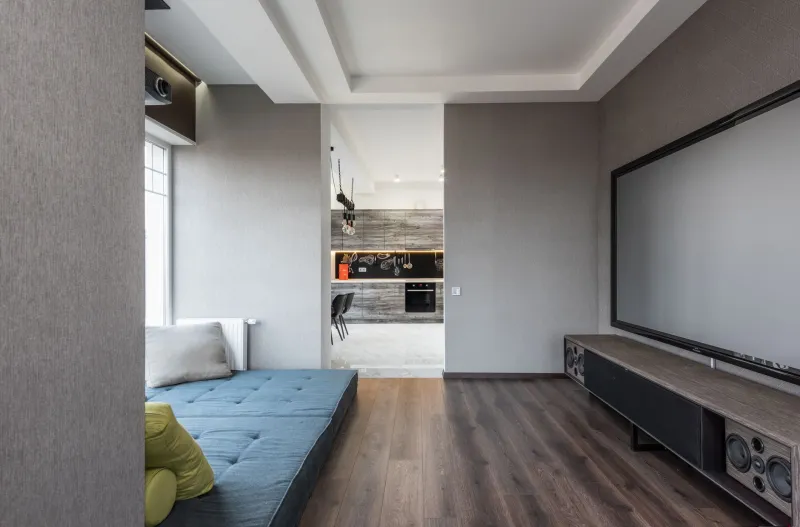
Renters have a different problem: no drilling. That rules out ceiling brackets, so the honest options are a short-throw or ultra-short-throw model sitting on a sideboard, a freestanding floor-to-ceiling pole where the ceiling allows it, or a conversation with the landlord. Command strips will not hold a projector, whatever the listing claims.
When to pay someone, and when not to
A straightforward ceiling install in a room with accessible joists and a socket already nearby is a two-hour job. Expect £120–£250 from a local AV fitter, or rather less if you have a handy friend and a laser level. Complex jobs — long cable routes through walls, conduit in a finished room, listed buildings, an ultra-short-throw that needs pixel-perfect alignment to a fixed screen — start around £300 and go up.
Office buyers have an extra layer: suspended ceilings need tile lifts and catenary wire kits (£25–£50 per point), building management may want method statements, and anything above head height in a shared space usually wants a second pair of hands and a risk assessment. Factor in half a day of someone's time.
Folding it into the net price
The rule is simple: net cost equals sticker price, plus everything needed to make it work, minus cashback, minus anything you genuinely would have bought anyway. Two projectors, same shelf, same brightness, very different reality:
- Projector A: £899, £150 cashback. Needs a £75 bracket, £70 fibre HDMI, £45 trunking and a £90 spur. Total outlay £1,179, net £1,029.
- Projector B: £999, £50 cashback. Short-throw, sits on a sideboard, needs only a £35 cable and a £20 shelf. Total outlay £1,054, net £1,004.
Projector A has three times the cashback and still loses. That is the whole point of the exercise.
A working budget, three ways
| Scenario | Typical install spend |
|---|---|
| Renter, shelf or sideboard setup | £40–£90 (shelf, cable, trunking, no drilling) |
| Homeowner, ceiling mount, DIY cable run | £150–£260 (bracket, fixings, cables, trunking, spur) |
| Homeowner, installed by a fitter | £300–£500 all in |
| Office, per ceiling point | £180–£350 including labour and catenary kit |
Two practical notes before you buy. First, keep every receipt — most cashback schemes only need the projector invoice, but bundle claims sometimes require everything on one order, and a mount bought separately may not count. Second, if a deal throws in a mount, check it is the right mount for your ceiling and your projector's hole pattern. A free bracket that does not fit is a £0 discount and a £70 problem.
The cashback is real money. So is the sparky, the fibre cable and the tin of filler. Compare the two together, and the deal that wins is usually the one that was easier to hang in the first place.